
Italian Annurca apple
Malus pumila Mill. cv. Annurca
Specialized botanical
A palm-source tocotrienol-rich fraction dominated by gamma-tocotrienol — the lesser-known, more lipid-soluble branch of the vitamin E family.

When it comes to hair loss, most people think immediately of two things: DHT (the factor behind male-pattern hair loss), and stress. Both leads are real, and both matter. But beyond them lies a third, less talked-about line — one that is just as backed by human data: oxidative stress.
Among the ingredients aimed at this line is a lesser-known branch of the vitamin E family: mixed tocotrienols. In an 8-month, placebo-controlled double-blind study, participants who took it daily saw their hair count rise by 34.5%, while the control group showed no significant change (Beoy 2010). *Results vary from person to person.
That figure is not earth-shattering — the hair-care market is never short of eye-catching numbers. What makes tocotrienols worth discussing is not that they are the most-researched ingredient (on sheer volume of research, Annurca apple and saw palmetto both go further), but that their mechanism is unusually clear, and fills a gap that often gets overlooked. This article begins with that gap.
First, a basic concept. Our bodies produce "reactive oxygen species" (ROS) every day — a normal by-product of metabolism, and not in itself a bad thing. The problem is balance: when ROS production outpaces the body's antioxidant systems' ability to clear it, that imbalance is called oxidative stress. Excess ROS act like "rust", gradually damaging cells' lipid membranes, proteins and DNA.
What does this have to do with hair? More directly than you might think. Hair follows a cycle of growth, regression and rest, and hair loss is often accompanied by a shortened growth phase, with follicles entering regression and rest early — that is, stopping growth and shedding sooner. Excess oxidative stress is one of the forces that push follicles in this direction.
This is not mere theory. Researchers comparing blood samples from people with male-pattern hair loss against others found that those with hair loss had lower total antioxidant capacity, while a marker of oxidative damage to lipids (MDA) was markedly higher (Prie 2016). In other words, in people with hair loss, the balance between oxidation and antioxidant defence is tilted.
Malus pumila Mill. cv. Annurca

Withania somnifera
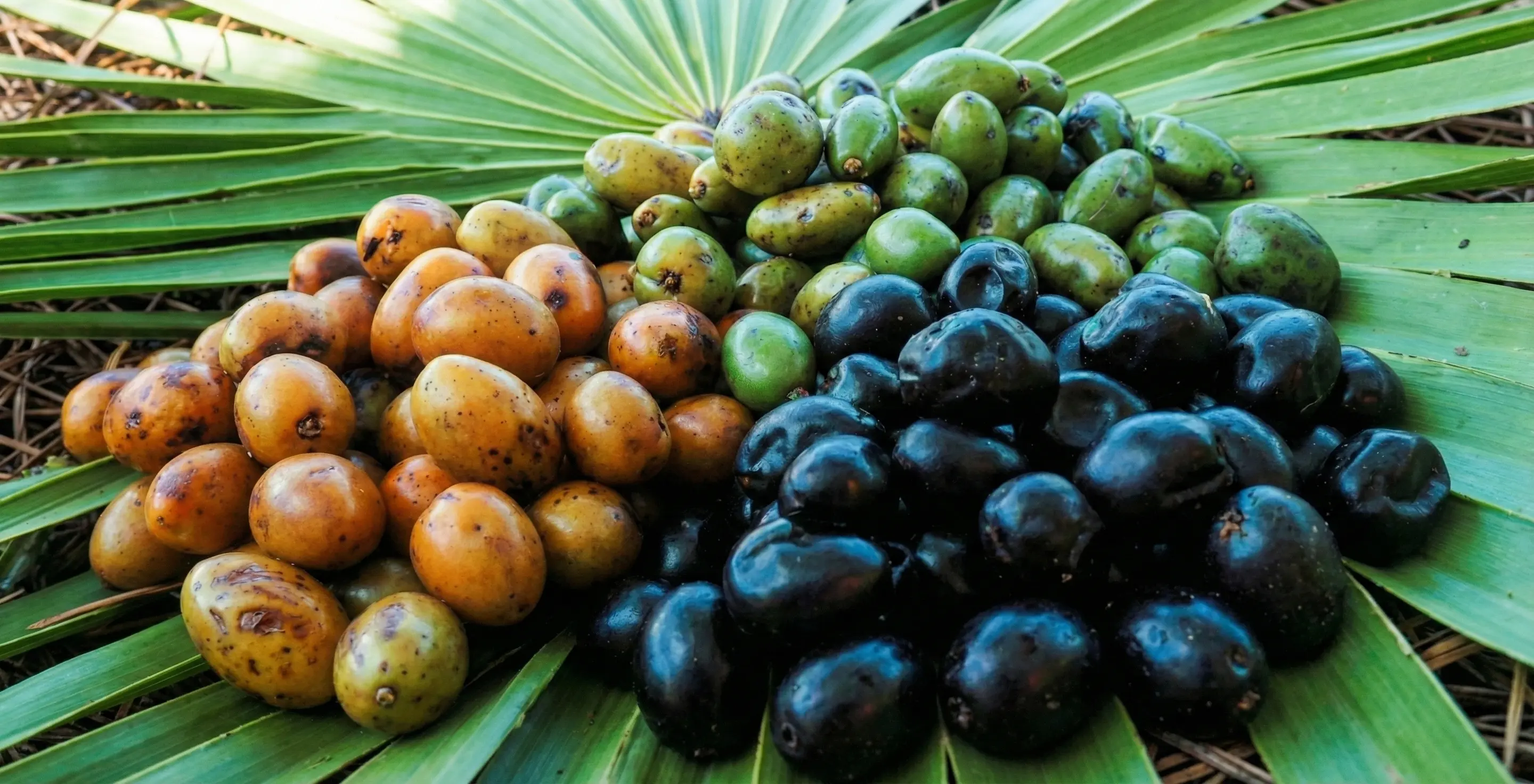
Serenoa repens (W. Bartram) Small

Cucurbita pepo L.
Zoom in on the follicle itself. At the base of each follicle sits a group of cells called dermal papilla cells — the command centre that regulates hair growth. Studies have found that dermal papilla cells taken from balding areas show higher ROS levels, age earlier, decline in activity, and even secrete signals that suppress hair growth (Upton 2015). Oxidative stress is regarded as one of the drivers of scalp and hair ageing (Trüeb 2021).
This raises a key question: if oxidative stress is one of the causes, then an antioxidant able to defend against it in the right place takes on real meaning. And that "right place" is the focus of the next section — the follicle is a tiny organ that is metabolically active and rich in lipids, and the cells' lipid membranes are the front line of lipid oxidation. To hold that line, you need an antioxidant that can genuinely enter the lipid membrane.
This brings us to a fact many people don't know: there is not one vitamin E, but a family of eight members — four "tocopherols" and four "tocotrienols" (Aggarwal 2010). The vitamin E we get day to day from supplements and cooking oils is almost entirely the most common, best-known one: alpha-tocopherol. Tocotrienols are the less familiar other half of the family.
The difference lies in the molecular structure. By way of analogy: the "tail" of a tocopherol is relatively rigid, while a tocotrienol's tail has an unsaturated structure that is softer and more flexible. Research comparing the two found that tocotrienols distribute more evenly within the lipid membrane, move more freely, and transfer more readily between membranes (Serbinova 1991; Yoshida 2003). Put simply, the research observed that they "get into" the lipid membrane more easily — and the lipid membrane is exactly the front line of oxidation described above.
This "getting in" brings a practical antioxidant advantage. In experimental models, tocotrienols' capacity to counter lipid oxidation reached 40 to 60 times that of ordinary vitamin E (Serbinova 1991). But an honest word is needed here: that multiple comes from a specific lipid experimental setting; under other assay conditions, the two perform comparably (Yoshida 2003). So the more accurate statement is this — tocotrienols' real advantage is that they "enter and hold the lipid membrane more easily", not a blanket "dozens of times stronger". Stating it precisely actually makes it more defensible.
So does orally taken tocotrienol reach the skin? Research indicates it does: studies have found that, whether taken through the diet or applied topically, tocotrienols enter skin tissue; in these studies, UV-induced oxidative damage at the skin level was also reduced (Traber 1997); a separate systematic review of the skin likewise documented tocotrienols' antioxidant performance at the skin level (Ghazali 2022). It should be added that these studies were mostly conducted at the skin level, not directly on the scalp follicle — but they reasonably show that this ingredient "reaches where it needs to go".
One more thing worth stating plainly: by the strictest nutritional definition, the term "vitamin E" refers only to alpha-tocopherol; tocotrienols are a comparatively less-studied branch of the family, and one the body metabolises more quickly (Azzi 2019). When this article describes them as "superior", it refers to their performance in the specific skill of "lipid-membrane antioxidant defence", not a claim that they beat ordinary vitamin E in every respect.
However elegant the mechanism, it must come back to people. The study mentioned at the outset is precisely the most direct human evidence for tocotrienols on the subject of hair.
This was a double-blind, placebo-controlled study: researchers recruited 38 people troubled by hair loss, having one group take 100 mg of mixed tocotrienols daily and the other a placebo, over 8 months (Beoy 2010). Hair was counted within a 2×2 cm area of each participant's scalp. The result: in the tocotrienol group, the average count rose from 285 to 383 hairs — a 34.5% increase at month 8 — while the placebo group held at about 289 hairs, with no significant change (P<0.05). As early as month 4, the active group had risen to about 328 hairs (a 15.2% increase). *Results vary from person to person.
| Timepoint | Active (mixed tocotrienols) | Placebo |
|---|---|---|
| Baseline | 285 hairs | ~289 hairs |
| Month 4 | ~328 hairs (+15.2%) | — |
| Month 8 | 383 hairs (+34.5%) | ~289 hairs (no significant change) |
It should be stated honestly that the material used in this study and the one used by HairBooster both belong to the same category of mixed / palm-source tocotrienols. Its results are therefore best understood at the "extract-category level"; as for the specific design and limitations of the individual trial, interested readers can verify them via the references at the end — which is why we list the full citations there.
Beyond efficacy, the tolerability of a daily supplement matters just as much. Tocotrienols are generally well tolerated; because they are fat-soluble, taking them with a meal aids absorption. The raw material used by HairBooster is food-grade quality: total tocotrienols and tocopherols at no less than 92%, heavy metals far below safety limits, microbial indicators undetected, and a 24-month shelf life.
There is also a point to flag honestly. At higher doses, tocotrienols may carry a mild antiplatelet (blood-clotting) tendency, so anyone taking anticoagulant or antiplatelet medication should consult a healthcare professional first. In addition, as a general product-safety consideration, pregnant and breastfeeding women are not among the suitable users.
Hair loss has long been dominated by the narrative of DHT and stress, but it also has an "oxidative" side that has been underrated for too long. Tocotrienols' strength lies not in the volume of research — they were never the most-studied star in this field — but in how clearly they make one point: against the often-overlooked gap of oxidation, the tocotrienol used in the research is a form of vitamin E that penetrates deep into the lipid membrane and stands out in antioxidant performance, backed by one cleanly-designed human study.
A clear mechanism, a superior form, and human evidence that — though only a single study — is solid: this is where tocotrienols sit in the anti-hair-loss puzzle. They may not be the most dazzling piece, but they are the one that fills the gap of oxidation most cleanly. For anyone who takes their hair seriously, understanding why an ingredient works and where it works is itself a kind of reassurance.
Important Note
Mixed tocotrienols are a nutritional supplement ingredient, not a medicine; they cannot replace formal medical treatment, and their effects should not be equated with those of a medical treatment. This kind of supplement is better suited to people in the mild-to-moderate stages of hair loss; if you are already at a more severe stage, the first choice should still be to seek professional medical help.
Understanding the value of this form makes the choice behind the Lemonvita HairBooster™ Gummies clear. HairBooster uses exactly this potent form — a palm-source tocotrienol-rich fraction, dominated by gamma-tocotrienol (gamma-tocotrienol makes up about 36% of the whole concentrate, and about half of the tocotrienol portion), with tocotrienols accounting for no less than 72% of total vitamin E. This defines the ingredient's identity by an actual analytical specification, rather than vaguely writing "with added vitamin E".
Is this single study a lone voice? Widening the view makes it clearer. In a 2025 network meta-analysis covering 16 hair-care supplements (a method that compares many studies within one framework), tocotrienols improved hair density significantly better than placebo, ranking third overall (Zhou 2025). Placed within this larger comparison, the direction this single study points to still holds.
The following are extended research in the field of mixed tocotrienols / antioxidant hair care, and are not directly cited in the discussion above: